
Created the training records for SOP-231 Rev 5.
One per operator · reminders on until each is complete
Solutions · Training & Competency
The SOP went live.The training didn't.
The workflow that releases a procedure should create the training that goes with it. It doesn't, so completion lags the effective date on every change. Unifize ties the training to the revision, the person and the proof they can do the work.
Is everyone trained on the current version? Read it off one chart
Runs wherever training records are inspected
Every role qualified for the version it works to.
The training work quality and operations actually run, as governed workflows: created by the change, owned by a named trainee and supervisor, closed on proof of competence.
Training that follows the change
A revised procedure, a deviation or an audit finding creates the training it implies.
- Training needs from document and process changes
- Retraining after a deviation or audit finding
Assignment and follow-through
Named trainees, their supervisors copied, and escalation before overdue training blocks the line.
- Assignment, completion tracking and escalation
- New-hire and role-change plans
- Periodic refreshers
Competency and qualification
What each role must be able to do, who can do it, and the evidence behind it.
- Competency assessment and qualification records
- Role qualification matrix
- Reassessment
The training happened. The record never heard.
The failure modes we see inside training and competency. None of them is a missing feature. All of them are training that happened off the record.
- Late training cascade after change closureThe procedure goes live. The training catches up weeks later.
- Training matrix is the first audit pull and the last system updatedNo daily work depends on it, so it is never current.
- Training completion ticks the box without competency evidenceThe record says trained. The floor says it depends.
- New hire ramp is a tribal-knowledge processWhen the trainer is out, the new hire stalls.
Every effective date reconciled against every training record, by hand. That reconciliation is the coordination tax.
Measure your coordination tax →Train on the change, before the change goes live.
Most training systems record a completion. Unifize creates the training from the revision, owns it with the named person and their supervisor, and closes it on a qualified trainer's sign-off, so the matrix is current because the work made it current.
One product runs the training work.
Training Management ships inside the Document Management System, linked to the controlled documents whose revisions create the training.
Runs in
Document Management System
Training created by the revision, owned by the person, closed on proof of competence.
Explore the product →It sits beside the systems you already run.
Keep the HR system that holds people and roles, and the learning system that holds courses. The training a revision creates runs on Unifize, tied to the controlled document, signed off with a 21 CFR Part 11 signature.
Proof, to the standard you'd hold us to.
A signed baseline, plus the teams who run their training on Unifize, in their own words.
- Customer-attested · medical devices41%lower non-conformance coordination cost, measured in year oneMedical-device manufacturer$81,350 a year recovered against a signed $198,150 baselineSigned baseline, anonymized
 Harmonic BionicsClarissa ArcherEvery change asks whether training is affected
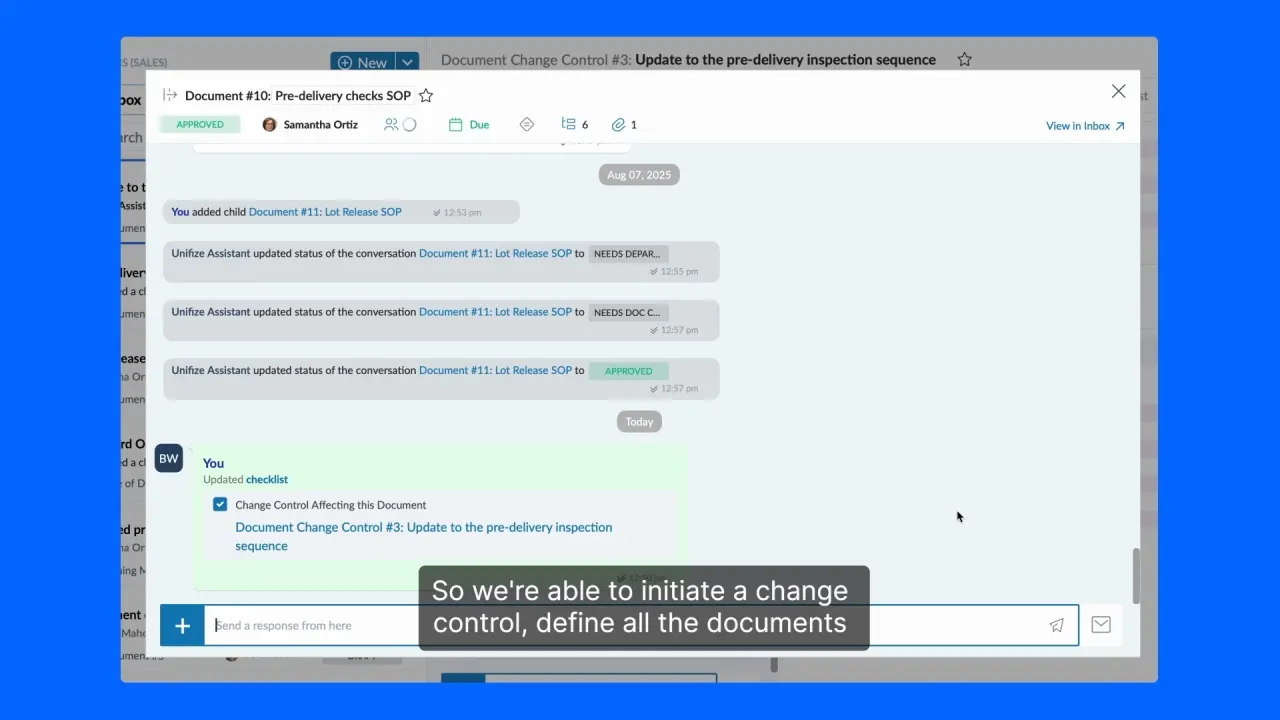 Jarod MarkleyMedical DevicesTraining sent at once to every group a revision affects
 Jarod MarkleyMedical DevicesTraining admin eliminated, tests and retraining automatic
 Biovation LabsJesse Kolstad, Director of QualitySOP to training to job to employee, ready on day one
 Biovation LabsJesse Kolstad, Director of QualityA badge scan shows if an employee is current on training
When training becomes the finding.
Each of these starts a clock, and each routes into training management, so the answer comes from the record instead of a reconciliation.
Audit finding on training records
Routes to Training Management · owned by VP Quality · Training
Change-driven training cascade gap
Routes to Training Management · Change Control · owned by Training · Quality · Operations
Version mismatch at site discovered
Routes to Training Management · Document Control · owned by Training · Document Control · Manufacturing

Trained on the version in use.
Bring one real procedure change and its training cascade, and see it run on your own work in a 30-minute walkthrough.